My fall run focus was cut short by the return of my calf strain (which never really healed all the way). So instead of the usual runtastic autumn, I've been enjoying some long bike rides. I try as much as possible to eat real food while doing these rides (typically 60-90km), as opposed to sports drinks or gels. I really tried to get into rice cakes, but a) couldn't get a recipe going I really liked and b) they don't respond well to being frozen.
This pancake recipe is now my preferred ride fuel. It's delicious, freezes well, and has a good mix of glycemic indexes from the the oats, bananas, and flour, so you get your calories absorbed over a span of time, which is good for long rides.
Ingredients:
1 cup flour
1 tsp baking powder
1/2 tsp baking soda
1/4 tsp salt
1 tsp cinnamon
2 tbsp ground flax + 1/4 cup water
1/2 cup oats
2 ripe bananas
3/4 cup water
1/2 cup crushed pecans
1 tbsp coconut oil
Instructions:
1. Get the flax soaking in a measuring cup with 1/4 cup water
2. Combine dry ingredients in a bowl
3. Stir in water and mix to make consistent batter, then add flax
4. Mash bananas in a smaller bowl until smooth, then add to batter
5. Stir in melted coconut oil and add pecans
6. Ladle batter into hot pan and cook until brown on either side
I put these pancakes in a ziplock bag and freeze them, taking one or two out when I'm about to head out on a long ride.
Wednesday, October 10, 2018
Wednesday, August 8, 2018
K-Town Duathlon
Race report coming for the Kingston Duathlon. Another new race for me and a fun experience. MSC definitely puts on a quality event. I was really happy with my race, which will most likely be my last multisport race of the season. Won my AG and got 4th overall (MSC has top 5 as the podium, so an overall podium for me here too). Time for a little r'n'r then on to my fall run focus.
Wednesday, July 11, 2018
First Race of the Season
My race report for the Sydenham Du is up. Fun to try out a new race after doing the same ones for a few years. Sydenham is a nice venue for multisport racing. The field was pretty small but some pretty fast folks showed up across the various races, including a few Ottawa-based professionals, at least one current Age Group World Champion, and multiple ITU World Championship qualifiers. It was a hot one out there, but not as bad as it's been over the past couple of weeks. As is often the case, the first race of the season serves as a reminder of some things I need to work on. I'll likely only get one more race in this year, so that'll be the real test.
Saturday, June 30, 2018
Recipe of the Month: Race Nutrition
I've tried a few different race nutrition options through the years. As a short course dude, nutrition isn't all that crucial compared to what it is in long course racing, but it can still make a difference at the tail end of a race, especially when it's really hot. I think a sprint race is totally doable without any nutrition at all, but I still like to have a little something on the bike just to make sure my blood sugar is topped up for the run and I'm also getting electrolytes in as I'm a heavy sweater and do plenty of races with temps running into the 30s.
I think if I were racing long course I'd separate my carbs from my electrolytes (i.e. eat calories, drink electrolytes), but in short course the intensity is not conducive to eating solids, and I just like to get what I need by sipping away during the bike.
I've used Skratch and Infinit with some success, but have fallen victim to the classic mistake of "I'll just mix this a little more concentrated that what's called for so I get more calories", not having any understanding of osmolarity. Of course the results were not pretty.
After having made my own protein bars for a couple of years, I figured I'd take a stab at race nutrition. For calories I mostly use maltodextrin, which is easily available at home brewing stores. Maltodextrin has a super high glycemic index, so enters your blood quicker than sugars. Because it consists of big molecules, it allows you to concentrate a lot more calories into a solution than other sugars like glucose or fructose, while still maintaining a proper osmolarity for absorption. There's also sucrose from the lemonade, which is absorbed through different channels so increases your caloric uptake, while having a slightly lower glycemic index, spacing out the rate at which the sugar enters your bloodstream.
For electrolytes I just use a Nuun tab - it's readily available and has everything you need. Coming up with a way to get all the necessary electrolytes in there some other way is more than I want to get involved with.
I have other variations of this recipe I use. For example my pre-race drink is made with green tea for caffeine, and is more evenly split between maltodextrin and sucrose. My Olympic distance mix is a greater quanitity, also with caffeine and some extra salt. I may post those sometime down the road.
I think if I were racing long course I'd separate my carbs from my electrolytes (i.e. eat calories, drink electrolytes), but in short course the intensity is not conducive to eating solids, and I just like to get what I need by sipping away during the bike.
I've used Skratch and Infinit with some success, but have fallen victim to the classic mistake of "I'll just mix this a little more concentrated that what's called for so I get more calories", not having any understanding of osmolarity. Of course the results were not pretty.
Maltodextrin comes in plastic baggies and looks very incriminating
After having made my own protein bars for a couple of years, I figured I'd take a stab at race nutrition. For calories I mostly use maltodextrin, which is easily available at home brewing stores. Maltodextrin has a super high glycemic index, so enters your blood quicker than sugars. Because it consists of big molecules, it allows you to concentrate a lot more calories into a solution than other sugars like glucose or fructose, while still maintaining a proper osmolarity for absorption. There's also sucrose from the lemonade, which is absorbed through different channels so increases your caloric uptake, while having a slightly lower glycemic index, spacing out the rate at which the sugar enters your bloodstream.
Like many of my ingredients, I get my lemonade from Costco
Sprint Drink:
6 tbsp maltodextrin
125 ml Kirkland Organic Lemonade
300 ml water
1 nuun active tab
Calories: 225
Magnesium = 25 mg
Potassium = 115 mg
Calcium = 13 mg
Sodium = 377 mg
Friday, May 25, 2018
Reflections on run training
When I first started running outside again this spring, I was dismayed at how my run fitness had deteriorated from last fall. But it's been steadily coming back. I'm still not where I was last fall, but I'm at least where I was this time last spring, so that's something.
Here are two runs along more or less the same route, a year apart:
So, pretty similar. Doesn't look like I'm starting this year in a different place fitness-wise from last year, which is disappointing because I'd hoped to make some run gains this winter. But it's looking way better than it had a month ago.
Unfortunately I've also developed another running injury. So far I've had run training derailed by patella-femoral syndrome, achilles tendonitis, and shin-splints/medial tibial stress syndrome. Time to add something new to the list: calf strain.
So I'm back off running for a while. This one has been building for a while, and in retrospect I made some poor decisions. As it's an injury I've never had before, I did really realize what was happening/what could happen. Why now?
One reason is the way I've been doing my runs. This year I'm doing a little more volume than last year, but the big difference is my frequency. For example, last year in early May I ran about 2:20 in a week, spread over 5 runs. This year I ran about the same duration, but in only 3 runs. I'm thinking that more, shorter runs is a better way to build volume, so perhaps I need to rethink my training schedule.
Realistically though, this injury was only exacerbated by my switch to outdoor running and the way I was doing it. I've been noticing tightness/pain in my calves (though one in particular) for a while now, stemming from some lower leg strength/conditioning work I'd been doing in order to avoid the shin splint/achilles issues I've had in the past. The discomfort was mild so I made no adjustments to my routine, but I really should have. I came into outdoor running season set up to fail with injuries that weren't healed. No surprise that outdoor mileage pushed them over the edge.
Too bad because I was just about ready to incorporate speedwork. But so far, it's looking like this injury will take a while to get better. At this point I have no idea when I'll be able to get into race shape this year, if at all. Running really is ridiculous. With the amount of effort I have to put into injury prevention/management, it's a wonder I do it at all. I periodically contemplate just becoming a full-time cyclist, and one of these years I'm going to do it.
Here are two runs along more or less the same route, a year apart:
| Date | Distance | Time | Avg pace | Avg HR |
| May 8 2017 | 10.24km | 0:53:56 | 5:16/km | 152 |
| May 1 2018 | 12.45km | 1:05:13 | 5:14/km | 153 |
Unfortunately I've also developed another running injury. So far I've had run training derailed by patella-femoral syndrome, achilles tendonitis, and shin-splints/medial tibial stress syndrome. Time to add something new to the list: calf strain.
So I'm back off running for a while. This one has been building for a while, and in retrospect I made some poor decisions. As it's an injury I've never had before, I did really realize what was happening/what could happen. Why now?
One reason is the way I've been doing my runs. This year I'm doing a little more volume than last year, but the big difference is my frequency. For example, last year in early May I ran about 2:20 in a week, spread over 5 runs. This year I ran about the same duration, but in only 3 runs. I'm thinking that more, shorter runs is a better way to build volume, so perhaps I need to rethink my training schedule.
Realistically though, this injury was only exacerbated by my switch to outdoor running and the way I was doing it. I've been noticing tightness/pain in my calves (though one in particular) for a while now, stemming from some lower leg strength/conditioning work I'd been doing in order to avoid the shin splint/achilles issues I've had in the past. The discomfort was mild so I made no adjustments to my routine, but I really should have. I came into outdoor running season set up to fail with injuries that weren't healed. No surprise that outdoor mileage pushed them over the edge.
Too bad because I was just about ready to incorporate speedwork. But so far, it's looking like this injury will take a while to get better. At this point I have no idea when I'll be able to get into race shape this year, if at all. Running really is ridiculous. With the amount of effort I have to put into injury prevention/management, it's a wonder I do it at all. I periodically contemplate just becoming a full-time cyclist, and one of these years I'm going to do it.
Friday, April 27, 2018
Recipe of the Month: Protein Bars
I'm going to start a recipe of the month feature here, since I do put quite a bit of thought into my nutrition. I have a few key philosophies:
#1 Eat real food - I really try to avoid buying prepackaged/mixed stuff. It's generally cheaper to make stuff yourself, and that way you know exactly what you're eating.
#2 Plant based - I know the vegan thing isn't everyone's cup of tea, but I try to be as plant-based as possible, but a variety of reasons (my own health and the health of our environment being two of the big ones).
So here's the first in a series of recipes I'll be sharing. I always make sure I get some protein into my body after a workout. I alternate between a protein shake (I use the Vega Protein & Greens powder from Costco) and this protein bar. This bar isn't really based on any particular recipe, and has undergone many iterations over the years as I've adjusted and refined it. In general, I've pared down the ingredients to make it as simple as possible, while making it more tasty (though making a delicious bar was never the priority) by upping the content of simple carbs, which is probably just as well in the interests of replenishing my glycogen stores after a workout (at least that's what I tell myself). This is the version of the recipe I've settled on. Each bar contains about 20g of protein, which is the most your body can absorb at a time, and contains all 9 essential amino acids.
Ingredients
#1 Eat real food - I really try to avoid buying prepackaged/mixed stuff. It's generally cheaper to make stuff yourself, and that way you know exactly what you're eating.
#2 Plant based - I know the vegan thing isn't everyone's cup of tea, but I try to be as plant-based as possible, but a variety of reasons (my own health and the health of our environment being two of the big ones).
So here's the first in a series of recipes I'll be sharing. I always make sure I get some protein into my body after a workout. I alternate between a protein shake (I use the Vega Protein & Greens powder from Costco) and this protein bar. This bar isn't really based on any particular recipe, and has undergone many iterations over the years as I've adjusted and refined it. In general, I've pared down the ingredients to make it as simple as possible, while making it more tasty (though making a delicious bar was never the priority) by upping the content of simple carbs, which is probably just as well in the interests of replenishing my glycogen stores after a workout (at least that's what I tell myself). This is the version of the recipe I've settled on. Each bar contains about 20g of protein, which is the most your body can absorb at a time, and contains all 9 essential amino acids.
Ingredients
1 cup dry mung beans
3 cups hemp hearts
2 cups chocolate chips
3/4 tsp salt
3 tbsp coconut sugar
3 tbsp ground flax disolved in 1 cup water
Directions
Boil mung beans for 10 min
Drain water, refill pot and return to boil
Reduce heat and simmer for 40 minutes
Mix flax and water and let rest for 10 minutes
Mix with other ingredients (except beans) in bowl
Add mung beans and immersion blend all ingredients
Spread in greased pan and bake @ 350 for 35 minutes
Chill and cut into 12 pieces
The flax is a source of Omegas, but is mainly used here for its effect as a binder. Mixing ground flax and water is known as a "flax egg" and works as a vegan substitute for eggs in most recipes.
The main source of protein in this recipe is the Hemp Hearts. Hemp is one of the few plant-based sources of protein to contain all 9 essential amino acids, making it a "complete protein".
After the beans are cooking I leave them pretty "soupy" - one of the things I've learned over making various versions of this recipe is you do want a good amount of liquid in there to help everything bake together into one solid block. I use Mung beans because they're easy to digest (i.e. they won't give you gas like other beans) and they're high in potassium and magnesium.

Once everything is mixed together I use the immersion blender to get it consistent. Not totally necessary, but I find it help to get an even texture and keep everything held together well.

Remember to grease the pan!

After it comes out of the oven and has cool, cut it into 12 even pieces.

And then individually wrap them and put them in the freezer.

Once everything is mixed together I use the immersion blender to get it consistent. Not totally necessary, but I find it help to get an even texture and keep everything held together well.

Remember to grease the pan!

After it comes out of the oven and has cool, cut it into 12 even pieces.

And then individually wrap them and put them in the freezer.
Sunday, April 1, 2018
Detraining
I had such hope and optimism for this season. With no swimming, I was going to put more emphasis on running, getting in more volume and progressing steadily using the 10% rule. My plan was to hit the spring with a solid aerobic base, starting outdoor running season at a good level of weekly mileage, ready to start integrating speedwork. I was going to race with better run fitness than I'd ever had before.
I was also hoping to put together a solid winter of training without having my gains stalled (or reversed) by repeated and/or extended bouts of illness. SPOILER ALERT: the year my training doesn't get derailed by illness ain't gonna be this year.
When it comes to training while sick, you're really damned if you do and damned if you don't. An article from Triathlon Magazine Canada from last year basically states that if you're really sick, don't train at all, and if it's just an above-the-neck sort of deal (sore throat, congestion, but no fever) then you can train, but don't exceed Zone 2 and no sessions beyond 45 minutes.
Discouragingly, according to running guru Hal Higdon “Research by Edward F. Coyle, Ph.D. at the University of Texas at Austin, suggests that runners begin to detrain (lose their fitness) after 48 to 72 hours, and that it takes two days of retraining to regain the fitness lost for every single day of training skipped." (Trainingpeaks blog). The article goes on to say, however, that the "loss can be somewhat avoided if you at least include in your schedule one to three days a week of maintenance training, especially if it incorporates high-intensity exercise that approaches VO2max."
Given the restriction on high intensity training while you're sick, however... that advice isn't particularly helpful in this instance. So here's the result of my terrible winter:
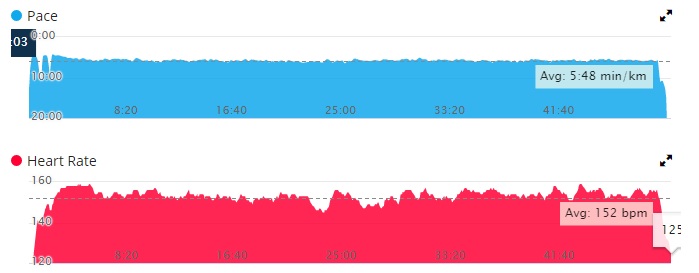
Above is the result of my second outdoor run this year, about 49 minutes of Zone 2 running. My average pace: 5:48/km. I did the first km in 5:32, then fell off into the 5:40s.
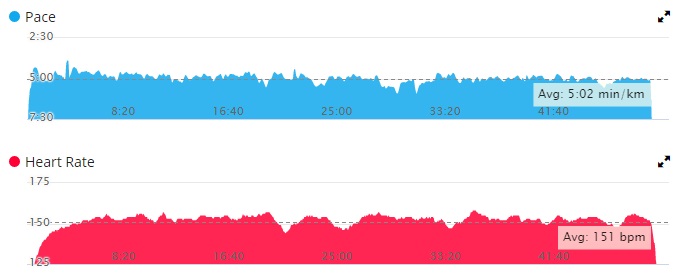
In contrast, here's a similar run from last year, albeit on a hillier route:
Same duration, but the average pace was 5:02/km. Indeed, I was able to run 9 full kilometres, all under 5:00/km while keeping my heart rate in Zone 2. In contrast, this spring I couldn't even run a single kilometre at that speed without blowing over Zone 2. I'm about 45s/km slower now than I was last year. This is what detraining looks like.
Amazingly, I haven't seen a significant loss in bike fitness. This is similar to my experience last fall when I barely biked at all for almost two months and started back on the trainer with only a slight loss in fitness. I was running a lot during that time period, so reasoned that I was still getting lots of cardio in that was translating well to the bike.
This winter, however, my extended bouts of illness meant I wasn't biking or running. But while my run fitness has suffered tremendously, by bike fitness has barely budged. I don't have any explanation for this, other than that maybe my body is just better suited to biking than it is to running (though I suppose this has been obvious for years).
So now the question is, how quickly can I regain my run fitness? Will I be able to race this year at or near the level I did last year? We'll see.
I was also hoping to put together a solid winter of training without having my gains stalled (or reversed) by repeated and/or extended bouts of illness. SPOILER ALERT: the year my training doesn't get derailed by illness ain't gonna be this year.
When it comes to training while sick, you're really damned if you do and damned if you don't. An article from Triathlon Magazine Canada from last year basically states that if you're really sick, don't train at all, and if it's just an above-the-neck sort of deal (sore throat, congestion, but no fever) then you can train, but don't exceed Zone 2 and no sessions beyond 45 minutes.
Discouragingly, according to running guru Hal Higdon “Research by Edward F. Coyle, Ph.D. at the University of Texas at Austin, suggests that runners begin to detrain (lose their fitness) after 48 to 72 hours, and that it takes two days of retraining to regain the fitness lost for every single day of training skipped." (Trainingpeaks blog). The article goes on to say, however, that the "loss can be somewhat avoided if you at least include in your schedule one to three days a week of maintenance training, especially if it incorporates high-intensity exercise that approaches VO2max."
Given the restriction on high intensity training while you're sick, however... that advice isn't particularly helpful in this instance. So here's the result of my terrible winter:
Above is the result of my second outdoor run this year, about 49 minutes of Zone 2 running. My average pace: 5:48/km. I did the first km in 5:32, then fell off into the 5:40s.
In contrast, here's a similar run from last year, albeit on a hillier route:
Same duration, but the average pace was 5:02/km. Indeed, I was able to run 9 full kilometres, all under 5:00/km while keeping my heart rate in Zone 2. In contrast, this spring I couldn't even run a single kilometre at that speed without blowing over Zone 2. I'm about 45s/km slower now than I was last year. This is what detraining looks like.
Amazingly, I haven't seen a significant loss in bike fitness. This is similar to my experience last fall when I barely biked at all for almost two months and started back on the trainer with only a slight loss in fitness. I was running a lot during that time period, so reasoned that I was still getting lots of cardio in that was translating well to the bike.
This winter, however, my extended bouts of illness meant I wasn't biking or running. But while my run fitness has suffered tremendously, by bike fitness has barely budged. I don't have any explanation for this, other than that maybe my body is just better suited to biking than it is to running (though I suppose this has been obvious for years).
So now the question is, how quickly can I regain my run fitness? Will I be able to race this year at or near the level I did last year? We'll see.
Wednesday, February 28, 2018
Good riddance, February
My year got of to a good start in January. Training was going well, but as is to be expected with one kid in school and one in daycare, germs ravaged the house in February and I've had this lingering illness for the entire month. I'm really hoping I get over it soon, as my training had been going well but has completely stagnated for the past few weeks.
One of the things I'm doing differently this year is taking rest more seriously. I don't do very much training volume (6 hours/week) so always figured that rest/recovery was not an issue. But when my TSS really ramped up last year, my fitness gains disappeared. Having a new baby and getting very little sleep was taking its toll. Stress is stress, whether it's training stress, work/life stress, illness, whatever. And not getting adequate sleep (I was on 3-4 hours a night for a lot of last winter/spring) is going really going to sabotage your training.
I was surprised last fall with very little "maintenance" biking that my bike fitness didn't decline all that much, and this has also informed my approach to rest this season. Last year when I was sick I'd take as little time off as possible and rush back into training. Unsurprisingly, it wouldn't be long before I got sick again. Now I'm on the "when in doubt, don't work out" program. If I have a bad night of sleep, I skip the next day's training session. If I'm sick, I wait until I'm recovered, then ease back into training with some shorter recovery efforts before hitting the hard intervals again.
Unfortunately this bug that's infiltrated our house is pretty tenacious. Hence my no-progress February. Hopefully March brings better luck. The warm weather has me anticipating getting outside again, which is always awesome after a winter of being cooped up inside.
Winter training set-up
I was surprised last fall with very little "maintenance" biking that my bike fitness didn't decline all that much, and this has also informed my approach to rest this season. Last year when I was sick I'd take as little time off as possible and rush back into training. Unsurprisingly, it wouldn't be long before I got sick again. Now I'm on the "when in doubt, don't work out" program. If I have a bad night of sleep, I skip the next day's training session. If I'm sick, I wait until I'm recovered, then ease back into training with some shorter recovery efforts before hitting the hard intervals again.
Unfortunately this bug that's infiltrated our house is pretty tenacious. Hence my no-progress February. Hopefully March brings better luck. The warm weather has me anticipating getting outside again, which is always awesome after a winter of being cooped up inside.
Thursday, January 18, 2018
Triathlon in Decline Part 2
Since I commented on the apparent decline in triathlon participation numbers in my neck of the woods back in September, the topic has come up again on slowtwitch, both as a thread on their forum and as an article on the front page. Obviously both of these are within a much larger context than my local analysis, but some interesting points were raised that caused me to take a second look at what the stats say about this issue.
I looked at what is likely the biggest local race, the Canadian, which takes place on Labour Day weekend and covers the largest range of distances (super sprint right up to half-iron in its current iteration). As per usual I didn't consider non-tri events (swim-cycle, duathlon, or relays). Additionally, since I was interested in the Age Group breakdown, I didn't consider athletes in the Try-a-Tri events or those that registered for other events as Clydesdales/Athenas, since neither of those include age categories.
I looked at what has happened to participation over a decade's time, to see if the patterns have changed. We already know the numbers are down, but rather than how many participants there were, I was more interested in who was participating. Here is the participation on all triathlon events at the Canadian by both males and females, broken down by age group.

The lower overall numbers are apparent, though there are couple of interesting exceptions:
In 2008, 31% of the women participating were under 30, and in 2017 this proportion had dropped slightly to just over 28%. For the men, the shift was a little bigger - in 2008 21.5% of participants were under 30, and by 2017 this number was down to just over 16%. It's to be expected that the average age is creeping up since we have an aging population, but it's also clear than younger males are not really into triathlon.
I noted in my last blog post on this subject that I think it's obstacle course racing like the Spartan Race and Tough Mudder that is drawing away many would-be triathletes - the industry has grown exponentially over that time period. For example, the 2017 Ottawa Spartan Race (the first edition of which, from what I can tell, was held in 2011) drew about 10 times the number of participants as the Canadian, despite having significantly higher entry fees ($125-$144).
A 2015 analysis of obstacle course racing puts the median age at 33, with a 63/37 male/female breakdown. A 2014 analysis of Tough Mudder specifically lists their median age as 29, with a 70/30 male/female breakdown. By comparison, according to TBI, the average triathlete is 44.
I'm not sure if I see these trends reversing. It's hard to beat the appeal of OCR - you can do it without any real training and it doesn't require any special equipment. It's also more social, both in terms of social media visibility and the fact that you can get bunch of your friends together to do it.
If Lionel Sanders manages to win Kona, this would likely put triathlon on more peoples' radar in this country. Likewise, if our mixed relay team medals in the 2020 Olympics, which I think they can, that would also go a long way to helping triathlon to a resurgence. On this point, the mixed relay format is pretty fun to watch, and the team aspect makes it more social. It would be interesting to see if this format is viable at the age group level. We've seen the increasingly popular swim-run events pop up recently in Ottawa, so the industry is willing to get on board with the trends. Maybe more non-traditional formats are the way to go. In the meantime the WTC races seem to be doing well, so perhaps the modern triathlete just doesn't want to race all that much and they'd rather drop the cash on one or two big expensive races per year, rather than race the more low-key local races. I don't really understand what's changed in that regard over the past decade, but it would seem to me that the big-ticket long course races have not experienced the same decline as small local races.
I looked at what is likely the biggest local race, the Canadian, which takes place on Labour Day weekend and covers the largest range of distances (super sprint right up to half-iron in its current iteration). As per usual I didn't consider non-tri events (swim-cycle, duathlon, or relays). Additionally, since I was interested in the Age Group breakdown, I didn't consider athletes in the Try-a-Tri events or those that registered for other events as Clydesdales/Athenas, since neither of those include age categories.
I looked at what has happened to participation over a decade's time, to see if the patterns have changed. We already know the numbers are down, but rather than how many participants there were, I was more interested in who was participating. Here is the participation on all triathlon events at the Canadian by both males and females, broken down by age group.
The lower overall numbers are apparent, though there are couple of interesting exceptions:
- F55-59 and M55-59 were unchanged
- F45-49 and M60+ were actually up
In 2008, 31% of the women participating were under 30, and in 2017 this proportion had dropped slightly to just over 28%. For the men, the shift was a little bigger - in 2008 21.5% of participants were under 30, and by 2017 this number was down to just over 16%. It's to be expected that the average age is creeping up since we have an aging population, but it's also clear than younger males are not really into triathlon.
I noted in my last blog post on this subject that I think it's obstacle course racing like the Spartan Race and Tough Mudder that is drawing away many would-be triathletes - the industry has grown exponentially over that time period. For example, the 2017 Ottawa Spartan Race (the first edition of which, from what I can tell, was held in 2011) drew about 10 times the number of participants as the Canadian, despite having significantly higher entry fees ($125-$144).
A 2015 analysis of obstacle course racing puts the median age at 33, with a 63/37 male/female breakdown. A 2014 analysis of Tough Mudder specifically lists their median age as 29, with a 70/30 male/female breakdown. By comparison, according to TBI, the average triathlete is 44.
I'm not sure if I see these trends reversing. It's hard to beat the appeal of OCR - you can do it without any real training and it doesn't require any special equipment. It's also more social, both in terms of social media visibility and the fact that you can get bunch of your friends together to do it.
If Lionel Sanders manages to win Kona, this would likely put triathlon on more peoples' radar in this country. Likewise, if our mixed relay team medals in the 2020 Olympics, which I think they can, that would also go a long way to helping triathlon to a resurgence. On this point, the mixed relay format is pretty fun to watch, and the team aspect makes it more social. It would be interesting to see if this format is viable at the age group level. We've seen the increasingly popular swim-run events pop up recently in Ottawa, so the industry is willing to get on board with the trends. Maybe more non-traditional formats are the way to go. In the meantime the WTC races seem to be doing well, so perhaps the modern triathlete just doesn't want to race all that much and they'd rather drop the cash on one or two big expensive races per year, rather than race the more low-key local races. I don't really understand what's changed in that regard over the past decade, but it would seem to me that the big-ticket long course races have not experienced the same decline as small local races.
Saturday, December 16, 2017
Looking ahead to 2018
As the new year approaches, it's time to start thinking about next season, identify the races I'll target, and schedule my training blocks accordingly. 2018 is going to be an interesting new chapter as I focus on duathlon. Most multisport races in eastern Ontario run one or more triathlon and duathlon events, though there are some events that only run as triathlons (Perth, Meech Lake, Barry's Bay), and a few that only run as duathlons (CMC spring/fall Du, Overdrive Series).
Duathlon Central has published a list of duathlon events for 2018, and though they cover two of the three Ontario multisport series (MSC and Subaru), for some reason (southern Ontario bias?) they don't give the Somersault series any coverage.
So, here is what I've been able to come up with for the eastern Ontario duathlon schedule for 2018.
The CMC Duathlons are pretty low key from what I understand, and they haven't established dates for those yet, I'm just guessing at when they'll run them based on previous years. Everything else is official.
An interesting mix of distances available. The usual sprint (2.5/20/5) and standard (5/40/10) distances, plus quite a few sprints with a 30K bike, which should appeal to strong cyclists. My threshold for "eastern Ontario" is races that I would reasonable drive to the morning of... hence my inclusion of the technically-in-Quebec Gatineau race (30 minute drive for me) but not, for example, the Overdrive races (about 3.5 hours).
I don't think any other races will materialize, unless some previously tri-only races offer duathlons, so this is likely what's on offer for 2018. I've got a good idea of which races I'll plan on, but as per usual we'll see where my fitness is and what life dishes out.
Duathlon Central has published a list of duathlon events for 2018, and though they cover two of the three Ontario multisport series (MSC and Subaru), for some reason (southern Ontario bias?) they don't give the Somersault series any coverage.
So, here is what I've been able to come up with for the eastern Ontario duathlon schedule for 2018.
The CMC Duathlons are pretty low key from what I understand, and they haven't established dates for those yet, I'm just guessing at when they'll run them based on previous years. Everything else is official.
| 2018 Eastern Ontario Duathlon Calendar | ||||
| Event | Length | Location | Date | |
May
| CMC Spring Du | 2/15/4 | Ingleside | 5/5/2018 |
| Early Bird | 2/33/5 | Ottawa | 5/19/2018 | |
June
| Ottawa River | Sprint and Standard | Ottawa | 6/9/2018 |
| Smiths Falls | Sprint | Smiths Falls | 6/23/2018 | |
July
| Gatineau | Sprint and Standard | Gatineau | 7/7/2018 |
| Sydenham | Sprint | Sydenham | 7/8/2018 | |
| Carleton Place | 2/30/5 | Carleton Place | 7/15/2018 | |
| National Capital | 2/30/5 and Standard | Ottawa | 7/28/2018 | |
August
| MSC Kingston | 4/30/7 | Kingston | 8/5/2018 |
| 1000 Islands | Sprint | Brockville | 8/19/2018 | |
| Cornwall | Sprint | Cornwall | 8/26/2018 | |
Sept
| The Canadian | 2/30/5 | Ottawa | 9/1/2018 |
| CMC Fall Du | 2/15/4 | Ingleside | 9/15/2018 | |
An interesting mix of distances available. The usual sprint (2.5/20/5) and standard (5/40/10) distances, plus quite a few sprints with a 30K bike, which should appeal to strong cyclists. My threshold for "eastern Ontario" is races that I would reasonable drive to the morning of... hence my inclusion of the technically-in-Quebec Gatineau race (30 minute drive for me) but not, for example, the Overdrive races (about 3.5 hours).
I don't think any other races will materialize, unless some previously tri-only races offer duathlons, so this is likely what's on offer for 2018. I've got a good idea of which races I'll plan on, but as per usual we'll see where my fitness is and what life dishes out.
Wednesday, November 29, 2017
Season Wrap-up: The Highlights
I have a tendency to dwell on the negative (derailed training plans, injury woes, poorly executed races), which is a shame since triathlon is generally pretty fun and has had an overwhelmingly positive impact on my life. So in the interest of smelling the roses, I figured I'd look back on this season focusing on the positives.
Beating my targeted swim time in the Perth Tri
After a frustrating lead-up to this race season, I wasn't totally sure of my swim fitness, but I knew if I swam to my capabilities I'd be out in under 8:30, and I was. Hitting a target like this is great in the first leg of the first race of the season, as it means I've got a pretty solid handle on my fitness, and helps to alleviate the uncertainty that comes with that first race. And it's always satisfying to perform to your capabilities.
Two overall podiums
I've consistently been a top-10 guy, but it was fun to actually be on the real pointy end this year. Despite earning podiums in Perth and Brockville, I was never really in contention for the win in either case. Race winners Jeff (Perth) and Marco (Brockville) were both in another zip code. So there's certainly lots more work to do, but getting to the overall podium level shows that I'm continuing to make progress.
Experiencing what it's like to be "the hunter" on the run
Running has historically been my weakness, and with a decent swim and a strong bike, I've consistently entered T2 ahead of some solid athletes who were better runners than me. Up until this year I've always started the run in fear, waiting for the inevitable as I lost position to superior runners. But after posting the second fastest run split in Perth, I was feeling confident for the Smiths Falls race, where I actually managed to pass 3 guys on the run, something I've never experienced before. Perhaps as importantly, nobody passed me. Although for various reasons I didn't execute the overall race I wanted, I finished feeling like a well-balanced triathlete. It's a totally different mentality to actually look forward to the run, saying "alright, let's hunt these guys down", rather than "oh crap, how long before the first guy passes me?"
Executing the race I wanted to in Brockville
My last multisport race of the season, and it all came together how I planned. I paced my efforts well in each leg, made smart decisions, and felt satisfied that I performed to my potential. A good way to end the season after some disappointments in Brockville in both 2015 and 2016.
Beating my targeted swim time in the Perth Tri
After a frustrating lead-up to this race season, I wasn't totally sure of my swim fitness, but I knew if I swam to my capabilities I'd be out in under 8:30, and I was. Hitting a target like this is great in the first leg of the first race of the season, as it means I've got a pretty solid handle on my fitness, and helps to alleviate the uncertainty that comes with that first race. And it's always satisfying to perform to your capabilities.
Two overall podiums
I've consistently been a top-10 guy, but it was fun to actually be on the real pointy end this year. Despite earning podiums in Perth and Brockville, I was never really in contention for the win in either case. Race winners Jeff (Perth) and Marco (Brockville) were both in another zip code. So there's certainly lots more work to do, but getting to the overall podium level shows that I'm continuing to make progress.
Experiencing what it's like to be "the hunter" on the run
Running has historically been my weakness, and with a decent swim and a strong bike, I've consistently entered T2 ahead of some solid athletes who were better runners than me. Up until this year I've always started the run in fear, waiting for the inevitable as I lost position to superior runners. But after posting the second fastest run split in Perth, I was feeling confident for the Smiths Falls race, where I actually managed to pass 3 guys on the run, something I've never experienced before. Perhaps as importantly, nobody passed me. Although for various reasons I didn't execute the overall race I wanted, I finished feeling like a well-balanced triathlete. It's a totally different mentality to actually look forward to the run, saying "alright, let's hunt these guys down", rather than "oh crap, how long before the first guy passes me?"
Executing the race I wanted to in Brockville
My last multisport race of the season, and it all came together how I planned. I paced my efforts well in each leg, made smart decisions, and felt satisfied that I performed to my potential. A good way to end the season after some disappointments in Brockville in both 2015 and 2016.
Thursday, November 9, 2017
Race Report: Cookie Run 10K 2017
This was originally my "A" race for the fall run season. After hitting my sub-20 minute 5K goal last year, this year the plan was to go sub-40 for a 10K. My oldest daughter is a Brownie, and was scheduled to work at this race as it's a fundraiser for Girl Guides. So it made sense to pencil this one in as the culmination of my fall run focus.
Things were looking up after my 5K on October 1st. Based on my time in that race, the McMillan run calculator predicted I could hit 40 minutes for a 10K, and I had 5 weeks to keep honing my run fitness. I had a great plan mapped out of progressive mileage, tempo runs, and speedwork. I knew reaching my goal would be a challenge, but felt confident in my fitness and training.
But, as outlined in my last blog post, the injury bug bit. It wasn't a sudden injury, but a cumulative one that really got exacerbated after the Great Gower Run. I was really worried it might be a stress fracture, or that it would turn into one if I kept running. Soft tissue pain is one thing but when your bone hurts, and you're facing the possibility of MONTHS off running, keeping up my run training was a risk I wasn't willing to take. I'm a multisport athlete first, so I'm never going to risk compromising my tri/du season for the sake of a running race.
So in an effort to keep my aerobic fitness, I got reacquainted with my trainer, and put in more cycle training than I've ever done before. I knew that cardio is one thing, but run-specific fitness is another, and so I devised a run-specific strength circuit in order to hopefully keep those muscles active.
One thing's for sure - I'm in great bike shape. After a good 6 weeks off of bike training, I was surprised to see I hadn't lost that much bike fitness. And by the end of my impromptu bike focus I was really smashing it. It would have been interesting to see what I could have done in a 40K TT.
With one week to go before the race, and really only a week after my pain went away, I got back on the treadmill. Two easy sessions and then some short race pace intervals, and no pain. Things were looking good. I was prepared to shut things down if the pain in my tibia re-emerged, but starting the race was a "go".
Race Day
It was below zero as we headed out to the venue. This race, along with several others over the course of the year, used to be held at a different venue, but for whatever reason (Canada 150 related?) quite a few races have moved to the Aviation Museum, using the Sir George-Etienne Cartier Parkway as the course. Not sure if this is a permanent thing or just a this year thing. Either way, it's a nice course. Great scenery, relatively flat (my Garmin shows 58m of elevation gain), and wide roads closed to traffic. And plenty of onsite parking (though it did fill up - we got there about an hour and a half early).
As a dude who doesn't do well in hot weather, I really like cold (but not subzero) runs. It was around 2 degrees when the race went off at 10am, which was just fine by me.
I figured that going sub-40 was going to be a long shot, but that was still going to be my goal. I wasn't interested in PBing - anything over 40 minutes would be a fail, whether I was over by 5 seconds or 5 minutes. So the plan was to try to hold 4:00/km as long as I could. If I made it all the way, fantastic. If I couldn't hold that pace, so be it.
This was the most congested start to a race I've experienced. There were about 900 runners at Rattle Me Bones last year, but the 5K and 10K started separately, and I managed to line up near the front on that one, along with a bunch of mostly fast runners. There were almost 1000 runners in this race, all starting simultaneously. And I didn't get to line up all that close to the front. There were some fast folks up front, but there were also a lot of people in front of me running at a more leisurely pace, with groups of friends, so it was a pretty congested first kilometre.
It was remarkable how quiet things got after the 2.5km turnaround. The 5K runners peeled off and I was left running with a small number of people running at around the same pace. I was running mostly by RPE at this point, still unsure of my run fitness, and glancing at my watch occasionally to see what sort of pace I was holding. I was keeping it under 4:00/km, and hit the 5K point at 19:52 (though actually making the turn at 19:56). I was on pace to break 40 minutes, and things up to that point had felt sustainable.
But accelerating out of that turn was somewhat labourious. And though I was still running at the pace I wanted for the next couple of kilometres, I was really killing myself to hold that pace. I was hyperventillating and started making these gasping/grunting sounds with every exhale. The runners passing me in the other direction were showing looks that alternated between genuine concern and what might have been outright horror. I was not in a good way, but was practicing what I call the alcoholic's approach: "You don't have to run the rest of the race at this pace, you just have to make it though the next kilometre." That worked for 2K.
Kilometre 7 clicked by at 28:03. I was now officially on pace to finish over 40 minutes. I knew if I could hold my current pace (at this point, 4:06/km) I'd hit that final K with 15 seconds to make up - actually more like 20 as my Garmin was ahead of the markers on the course. At North Gower I ran that final K right around 3:45/km. So maybe breaking 40 was technically still possible. Except for two things: #1, there was no way I was going to be able to hold my current pace - things were headed in the wrong direction and I was on the rivet; #2 to run the final K here faster than I ran the final K in a race half the distance... well, highly unlikely.
So the dream died at the 7km mark. I eased up and began running at 4:20/km pace. It was enough to get my breathing under control and bring my heart rate down a few BPMs. Unsurprisingly, people started passing me, including some guys I had passed before the turnaround. But I was at peace with my race - I was still running hard, but it wasn't the sufferfest that the last couple of kilometres had been.
With one km to go I made a brief attempt to pick back up to 4:00/km, but it was too hard for 1000m, so I backed off. I did get a good finishing sprint in as there was a dude just up ahead of me that I raced for the line. I thought I probably got in under 41 minutes, but my chip time was 41:10, so not quite. If I'd run a different race tactically, I probably could have gone around 40:30, but I chose to go all-in for the slim chance I'd actually be able to hold onto a sub-40 pace, and paid the price. But 40:30 wouldn't have felt any better than 41:10, so I had nothing to lose with my gamble.
Official Time: 41:26
Chip Time: 41:10
24/297 Overall
10/29 M30-39
I'm not disappointed in failing to reach my goal, given the circumstances. Mostly I'm just relieved that my shin pain didn't re-emerge during or after the race. But I'm really hungry to make sub-40 next year (I'm also keen to break 19 for the 5K). I think both should be doable as long as I remain injury-free, but that's always the caveat. Despite some setbacks, I've been trending in the right direction in that regard.
Lessons learned:
1) There's no substitute for running. I was able to maintain a good amount of fitness, but not run-specific fitness. I don't think my strength routine was necessarily misguided, but it wasn't giving my body what running would. I think specifically the plyometric aspect was lacking, though I'm not sure how I could have incorporated that type of work without compromising my recovery. And ultimately I didn't lost that much run fitness, but I do think I would have put up a better time a month ago. Where I really noticed it was after the race. I've never been so sore after any race, even three days later I was feeling it, and that's what happens when you all of a sudden ask your muscles to give everything they've got after a month off.
2) Running really eats into your bike fitness. I've never done a bike-only focus like I did in October, and the difference between only biking (and doing it 5-6 times a week) and dividing your time between biking and running is huge. It does make me wonder what I could actually do if I ever decided to become a single-sport athlete.
Things were looking up after my 5K on October 1st. Based on my time in that race, the McMillan run calculator predicted I could hit 40 minutes for a 10K, and I had 5 weeks to keep honing my run fitness. I had a great plan mapped out of progressive mileage, tempo runs, and speedwork. I knew reaching my goal would be a challenge, but felt confident in my fitness and training.
Ready to race on a chilly November morning
So in an effort to keep my aerobic fitness, I got reacquainted with my trainer, and put in more cycle training than I've ever done before. I knew that cardio is one thing, but run-specific fitness is another, and so I devised a run-specific strength circuit in order to hopefully keep those muscles active.
One thing's for sure - I'm in great bike shape. After a good 6 weeks off of bike training, I was surprised to see I hadn't lost that much bike fitness. And by the end of my impromptu bike focus I was really smashing it. It would have been interesting to see what I could have done in a 40K TT.
With one week to go before the race, and really only a week after my pain went away, I got back on the treadmill. Two easy sessions and then some short race pace intervals, and no pain. Things were looking good. I was prepared to shut things down if the pain in my tibia re-emerged, but starting the race was a "go".
Race Day
It was below zero as we headed out to the venue. This race, along with several others over the course of the year, used to be held at a different venue, but for whatever reason (Canada 150 related?) quite a few races have moved to the Aviation Museum, using the Sir George-Etienne Cartier Parkway as the course. Not sure if this is a permanent thing or just a this year thing. Either way, it's a nice course. Great scenery, relatively flat (my Garmin shows 58m of elevation gain), and wide roads closed to traffic. And plenty of onsite parking (though it did fill up - we got there about an hour and a half early).
As a dude who doesn't do well in hot weather, I really like cold (but not subzero) runs. It was around 2 degrees when the race went off at 10am, which was just fine by me.
I figured that going sub-40 was going to be a long shot, but that was still going to be my goal. I wasn't interested in PBing - anything over 40 minutes would be a fail, whether I was over by 5 seconds or 5 minutes. So the plan was to try to hold 4:00/km as long as I could. If I made it all the way, fantastic. If I couldn't hold that pace, so be it.
Navigating my way through the crowd
It was remarkable how quiet things got after the 2.5km turnaround. The 5K runners peeled off and I was left running with a small number of people running at around the same pace. I was running mostly by RPE at this point, still unsure of my run fitness, and glancing at my watch occasionally to see what sort of pace I was holding. I was keeping it under 4:00/km, and hit the 5K point at 19:52 (though actually making the turn at 19:56). I was on pace to break 40 minutes, and things up to that point had felt sustainable.
But accelerating out of that turn was somewhat labourious. And though I was still running at the pace I wanted for the next couple of kilometres, I was really killing myself to hold that pace. I was hyperventillating and started making these gasping/grunting sounds with every exhale. The runners passing me in the other direction were showing looks that alternated between genuine concern and what might have been outright horror. I was not in a good way, but was practicing what I call the alcoholic's approach: "You don't have to run the rest of the race at this pace, you just have to make it though the next kilometre." That worked for 2K.
Kilometre 7 clicked by at 28:03. I was now officially on pace to finish over 40 minutes. I knew if I could hold my current pace (at this point, 4:06/km) I'd hit that final K with 15 seconds to make up - actually more like 20 as my Garmin was ahead of the markers on the course. At North Gower I ran that final K right around 3:45/km. So maybe breaking 40 was technically still possible. Except for two things: #1, there was no way I was going to be able to hold my current pace - things were headed in the wrong direction and I was on the rivet; #2 to run the final K here faster than I ran the final K in a race half the distance... well, highly unlikely.
So the dream died at the 7km mark. I eased up and began running at 4:20/km pace. It was enough to get my breathing under control and bring my heart rate down a few BPMs. Unsurprisingly, people started passing me, including some guys I had passed before the turnaround. But I was at peace with my race - I was still running hard, but it wasn't the sufferfest that the last couple of kilometres had been.
With one km to go I made a brief attempt to pick back up to 4:00/km, but it was too hard for 1000m, so I backed off. I did get a good finishing sprint in as there was a dude just up ahead of me that I raced for the line. I thought I probably got in under 41 minutes, but my chip time was 41:10, so not quite. If I'd run a different race tactically, I probably could have gone around 40:30, but I chose to go all-in for the slim chance I'd actually be able to hold onto a sub-40 pace, and paid the price. But 40:30 wouldn't have felt any better than 41:10, so I had nothing to lose with my gamble.
Official Time: 41:26
Chip Time: 41:10
24/297 Overall
10/29 M30-39
Getting my finisher's medal from my daughter
Lessons learned:
1) There's no substitute for running. I was able to maintain a good amount of fitness, but not run-specific fitness. I don't think my strength routine was necessarily misguided, but it wasn't giving my body what running would. I think specifically the plyometric aspect was lacking, though I'm not sure how I could have incorporated that type of work without compromising my recovery. And ultimately I didn't lost that much run fitness, but I do think I would have put up a better time a month ago. Where I really noticed it was after the race. I've never been so sore after any race, even three days later I was feeling it, and that's what happens when you all of a sudden ask your muscles to give everything they've got after a month off.
2) Running really eats into your bike fitness. I've never done a bike-only focus like I did in October, and the difference between only biking (and doing it 5-6 times a week) and dividing your time between biking and running is huge. It does make me wonder what I could actually do if I ever decided to become a single-sport athlete.
Subscribe to:
Posts (Atom)